Byrne's Dictionary of Irish Local History by Joseph Byrne
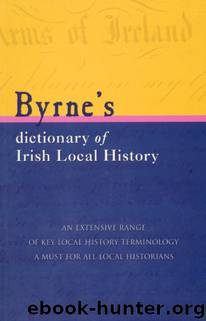
Author:Joseph Byrne [Byrne, Joseph]
Language: eng
Format: epub
ISBN: 978 1 85635 800 2
Publisher: Mercier Press
M
mace. A club, usually of iron with a wooden handle, designed to smash defensive armour.
machicolation. An opening in the floor of a projecting parapet or in the roof of an entrance through which missiles, stones or hot liquids might be cast upon attackers. A murder-hole.
madder. A climbing plant (rubia tinctorum), the root of which was used to make a medium to strong red dye.
maghery. (Ir., machaire, a plain) The area controlled by the English administration during the fifteenth century comprising the Pale and its marches (borders). The 1488 Act of Marches and Maghery defined the Pale boundaries as stretching from Dundalk to Dalkey and as far inland as 20 miles. By a series of parliamentary subsidies the maghery was enclosed piecemeal by ditches and castles as a defence against Irish raids. In 1495 Poynings’ parliament obliged the march inhabitants to construct a double rampart and ditch on the boundary of the march with the maghery and additional ditches between the marches and the Irish. For defensive rather than administrative purposes the term ‘maghery’, the land of peace, was sometimes applied to the Pale to distinguish it from the marches, the land of war. (Ellis, Reform, pp. 50–52.)
magistrate. Dissatisfaction with the competence of many justices of the peace led to the emergence in Ireland of the magistrate. Lay part-time magistrates exercised the same judicial powers as a justice of the peace at the quarter-sessions but like the justices they proved unsuitable despite efforts by successive governments to improve their effectiveness. In 1795 (33 Geo. III c. 36) whole-time stipendiary magistrates exercising control over the city police force were appointed in Dublin. Stipendiary magistrates were introduced to be independent of local (especially Orange and Protestant) influence and control. This initiative proved so successful that from 1814 the lord lieutenant was empowered to appoint ‘magistrates of police’ and an attendant constabulary force to pacify proclaimed areas. After 1822 resident stipendiary magistrates with no connection to the police could be appointed at the request of the justices of the county. Finally, the 1836 act (6 & 7 Will. IV, c. 13) which legislated for a national constabulary force also provided for the appointment of resident magistrates throughout the country. These, too, were independent of the police and reported to the chief secretary on the state of their districts. By 1912 there were 64 resident magistrates operating outside Dublin. The magistrate presided over presentment sessions of the grand jury at the assizes, acted as an ex-officio member of the board of guardians of a poor law union and in the mid-nineteenth century could appoint police sub-constables. See police.
mail. Iron links woven into a metal shirt which was worn to protect the wearer from slashing blows during combat. It was less effective against piercings.
mainprise. The action of procuring the release of a person – who would otherwise be committed to jail – by going surety for his appearance in court on a specific date.
mainpernor. 1: The surety for a released prisoner’s appearance in court on a specific date 2: A person who goes surety.
Download
This site does not store any files on its server. We only index and link to content provided by other sites. Please contact the content providers to delete copyright contents if any and email us, we'll remove relevant links or contents immediately.
| Africa | Americas |
| Arctic & Antarctica | Asia |
| Australia & Oceania | Europe |
| Middle East | Russia |
| United States | World |
| Ancient Civilizations | Military |
| Historical Study & Educational Resources |
Room 212 by Kate Stewart(5121)
The Crown by Robert Lacey(4817)
Endurance: Shackleton's Incredible Voyage by Alfred Lansing(4783)
The Iron Duke by The Iron Duke(4356)
The Rape of Nanking by Iris Chang(4213)
Joan of Arc by Mary Gordon(4112)
Killing England by Bill O'Reilly(4003)
Say Nothing by Patrick Radden Keefe(3986)
I'll Give You the Sun by Jandy Nelson(3447)
Shadow of Night by Deborah Harkness(3368)
Hitler's Monsters by Eric Kurlander(3343)
Mary, Queen of Scots, and the Murder of Lord Darnley by Alison Weir(3210)
Blood and Sand by Alex Von Tunzelmann(3205)
Eleanor & Park by Rainbow Rowell(3175)
Darkest Hour by Anthony McCarten(3133)
Margaret Thatcher: The Autobiography by Thatcher Margaret(3082)
Book of Life by Deborah Harkness(2939)
Red Famine: Stalin's War on Ukraine by Anne Applebaum(2934)
The One Memory of Flora Banks by Emily Barr(2863)
